Tim Johnson
Tim Johnson is the pet dog of Maycomb, a liver-colored bird dog owned by Mr. Harry Johnson, who drives the Mobile bus and lives on the southern edge of town. Known as the pet of Maycomb, Tim Johnson is a familiar, harmless presence in the neighborhood. His sudden transformation into a rabid animal and his death at the hands of Atticus Finch form one of the novel's most dramatic and revealing episodes, shattering Scout and Jem's perception of their father as feeble and unremarkable and introducing a new, more complex definition of courage.
Identity and Background
Tim Johnson is a liver-colored bird dog, the property of Mr. Harry Johnson. He is described as "the pet of Maycomb," a familiar and unremarkable fixture of the town's daily life. On a Saturday in February, Jem and Scout notice him behaving strangely while they are out exploring with their air-rifles. Tim Johnson is not running or playing; he is moving erratically, as if his right legs were shorter than his left legs, reminding Scout of a car stuck in a sandbed. He walks dazedly, dedicated to one course and motivated by an invisible force, shivering like a horse shedding flies. Jem observes that he is "goin' like that, only not like he means to," and Calpurnia, after seeing him, immediately identifies him as a mad dog.
The Crisis and the Shooting
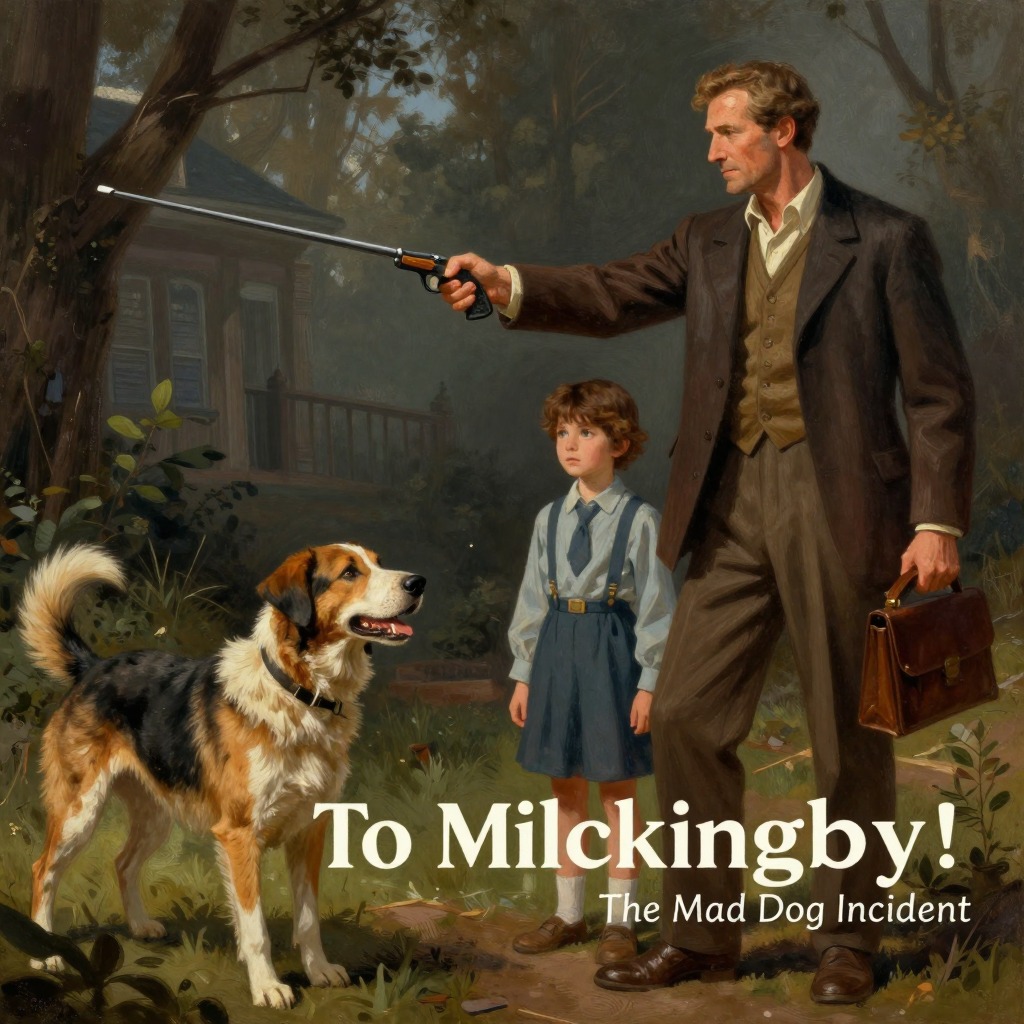
Calpurnia, recognizing the danger, rushes the children inside and telephones Atticus's office, shouting that there is a mad dog coming down the street. She then calls Eula May, the town's telephone operator, to warn the neighbors, and runs to the Radley Place to pound on the door, shouting a warning to Mr. Nathan Radley and Boo Radley, though no one answers. Sheriff Heck Tate arrives with Atticus in a black Ford. The sheriff, carrying a heavy rifle, assesses the situation and, despite Atticus's protests that he hasn't shot a gun in thirty years, insists that Atticus take the shot. The sheriff argues that the dog is positioned in front of the Radley house and that he cannot shoot that well. Atticus takes the rifle, pushes his glasses to his forehead, drops and breaks them, and then, with movements so swift they seem simultaneous, yanks a ball-tipped lever as he brings the gun to his shoulder. The rifle cracks, and Tim Johnson leaps, flops over, and crumples on the sidewalk in a brown-and-white heap. Sheriff Tate later confirms that Atticus was a little to the right, hitting the dog above the left eye, and Atticus admits he always was, preferring a shotgun.
Revelation and Aftermath
The shooting reveals a hidden dimension of Atticus's character. Miss Maudie Atkinson tells the stunned Jem and Scout that Atticus Finch was "the deadest shot in Maycomb County in his time," known as "Ol' One-Shot" when he was a boy. She explains that he never hunted because he was "civilized in his heart" and put his gun down when he realized God had given him an unfair advantage over most living things, deciding he wouldn't shoot until he had to. Jem, in a state of numb confusion, tells Scout not to say anything about it at school, reasoning that if Atticus had wanted them to know, he would have told them. Jem then declares, "Atticus is a gentleman, just like me!" The dead dog is collected by Zeebo, who uses a pitchfork to lift it onto the garbage truck and pours something on the spot where it fell, warning the children to stay away.
Thematic Significance
Tim Johnson's death is a crucial moment in the children's moral education. It directly precedes Atticus's later definition of real courage as "when you know you're licked before you begin but you begin anyway and you see it through no matter what," a lesson he illustrates with Mrs. Dubose's battle against morphine addiction. The episode also establishes that true strength is not about physical prowess or public display but about quiet competence and moral restraint. Atticus's skill with a gun, a talent he never boasts about, becomes a metaphor for the power he holds in check, a power he uses only when absolutely necessary to protect the community. The event also foreshadows the greater, more dangerous conflict of the Tom Robinson trial, where Atticus will again be called upon to act with courage and precision in the face of a threat that is not merely physical but social and moral.